darkweb depictions
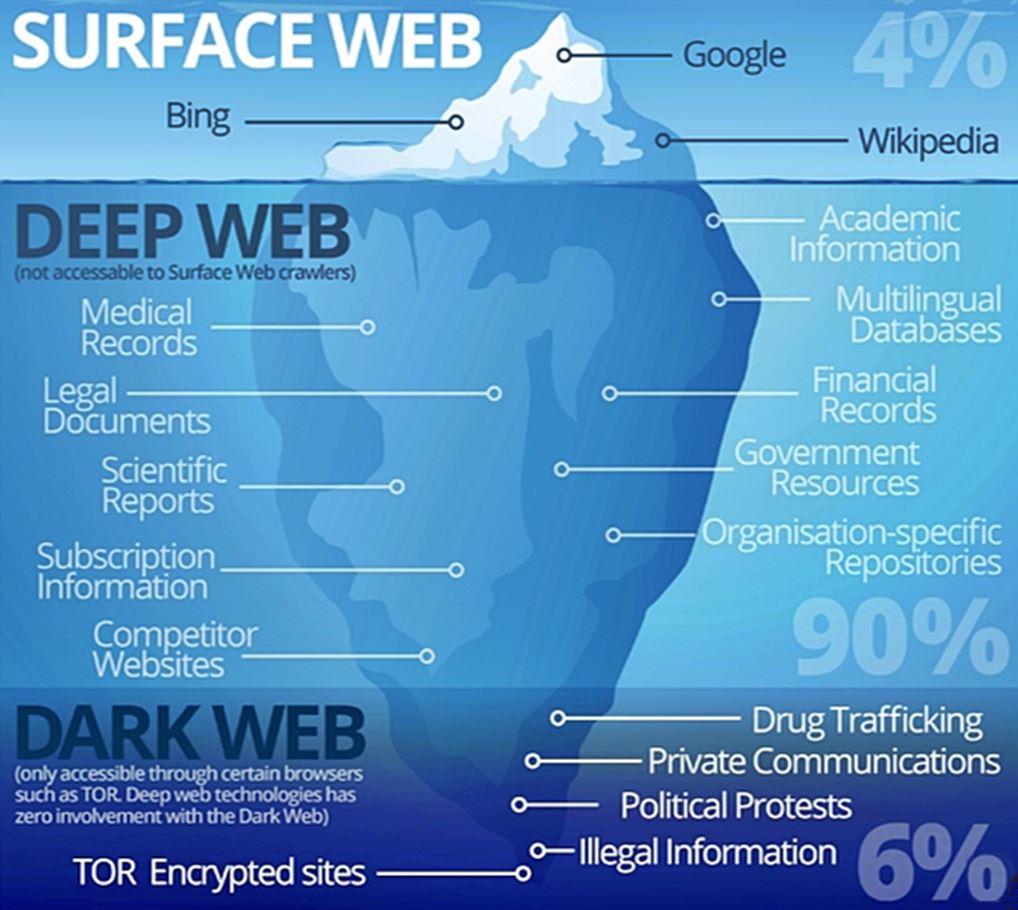
The iceburg metaphor seems right, but the details are sus. I wonder where the data comes from, but have no idea what the actual percentages ought to be. It does seem like these images are not accurate, but simply assume without basis in fact, that others are correct. I see images like this all the time!
The detail seems inconsistent as well, with brands listed on top, then lists of things by data type or category in the middle and bottom sections. I would expect the 90% shown as "deepweb" to be brands like Facebook, Twitter, Instagram, Tiktok, along with platform types like hospitals, credit agencies, etc. The platforms and brands that keep data behind authentication walls can be collectively be called the "deepweb".
The 6% shown as darkweb is the most misleading of the sections. The explainer that darkweb sites depend on "certain browsers" is a mischaracterization, as most overlay networks and mixnets do not use special browsers. Even Tor, the one mentioned, only requires the daemon to be running. It is not limited to "web" traffic, but can proxy many types of internet traffic.
I suppose this is at the heart of my discomfort with the depiction of "darkweb" versus "deepweb" and "surfaceweb". It seems that either HTTP(S) traffic is all that is considered here, or that "web" is conflated wih "internet". You can operate a Bitcoin node that communicates to peers over Tor. Music streams and video torrents are commonplace on I2P network. When we include everything from email messages to torrents, we get a more holostic picture.
I would urge readers to think of these categories as "clearnet", "deepnet" and "darknet", although it is not clear how much of each section is non-HTTP in nature. Otherwise how do we account for peer-to-peer communications, for example?
Which brings me finally to my number one gripe about this image, which is representative of so many images commonly bandied about. Why does every depiction have the percentages as 4%, 90%, and 6%? Due to the difficulty of surveying the bottom two layers, shouldn't we expect variation in results?